
What I Learned in Chainsaw 101 Class: Mindset, Dating and Fierce Independence
Because I live in the woods and fire danger is real it’s essential that I clear my property of trees and brush. I bought a home on several acres with no shortage of work to do. If I had a million dollars..., right! But it’s just me, alone with my big dreams of chickens, goats, flower gardens, puppies and making a space that is homey and inspiring for living, writing, yoga, healthy huntress retreats and my new studio Air B&B. It’s me who is trying to learn if I keep the larch and harvest the Doug fir? Or, is it the Grand fir I keep, and the larch I cut down? (You tree people, know that’s a tree joke! Keep the larch!) I actually did know that little bit before signing up for the class.
There was loads of learning about trees, safety, and techniques, but these are a few of my practical, and some very personal, take home chainsaw training gems.
1. Full throttle. You don’t chainsaw a tree with the same technique as a chiropractic adjustment. In chiropractic, we ease into the tissue, take out the slack and then deliver a short, quick thrust. Oh, No, No, No! Not with a chainsaw. You let that baby rip!
Throttle speed has to be up before making contact, and it stays up all the way through the wood until you come out the other side (hopefully.) This is what made the chainsaw intimidating for me. Full freaking throttle. This approach is opposite too many things in life.
“Maybe, this mindset will improve my dating life,” I joked with Emma and Hank. “How so,” Emma asked. “Well, I am a little reserved. Maybe, I could practice more committment.” She laughed, and I’m pretty sure she didn’t fully understand my flippant comment. We did have on ear protection, and she didn’t know me very well. What I meant was, or what I was experiencing was that when the chainsaw gets up to speed and you go to make a cut you have to commit to it. Sure, you must have situational awareness and feel it out and listen for how a cut is going but you have to full on keep that saw going. And, AND, you have to let the saw do the work.
My technique went like this: half rev up the saw, go into it gently like I was testing it out, then slow down, then pull back, then start over and I wasn’t trusting the saw to do the work and move through the log. I was kind of trying to swing my saw like a bat and push my way through it. I was trying to do the work of the saw, be the saw. Eh hem. Know your tools, trust your tools, let your tools perform, be one with the saw.
Using the chainsaw was a completely different mindset for me. I must say I quite liked the feeling of safety and full throttle and ease all at once. Maybe, I could approach dating with that kind of interest and personal confidence. Trust I could go in and get out the other side without the feeling of so much caution and hitting the brakes. Change my approach and expectation and enjoy the experience.
This ah ha experience was less about dating and more about what it feels like to embody committing to really moving through something physically and mentally. It could be pushing a shovel into the earth, painting a wall, stepping to the front of a yoga mat. The difference was the amount of power and risk inherent with the action.
2. Body mechanics. I was glad when one of the participants said, “I’m getting older and I can feel this really bothers my back. Any tips to prevent this hurting so much the next day?”
Excellent question I thought and raised my hand to speak. “Center of gravity is imperative to this type of work,” I said. Not that I knew a danged thing about chainsaw positions but I’m pretty good at understanding body mechanics. I rarely bend at the waist to adjust a patient. I stand wide legged, weight in my legs, feet flat on the floor and use my center of gravity to move forward, backwards and sideways.
You can’t hug a chainsaw too close because it is a dangerous power tool. However, you can’t be bending over or twisting with a big weight too far away or those smaller neck and shoulder and lower back muscles will be taking a beating.
I suggested limiting too much bending at the waist, keeping a slight bend in the knees as much as possible and taking more breaks than you think you need. Like most things, the more you do it the stronger you’ll get at the unique motion patterns of working with a chainsaw. Perhaps, some kettlebell training can simulate these movement patterns. Maybe I should offer a workshop on body mechanics for chainsawing-before, during and after.
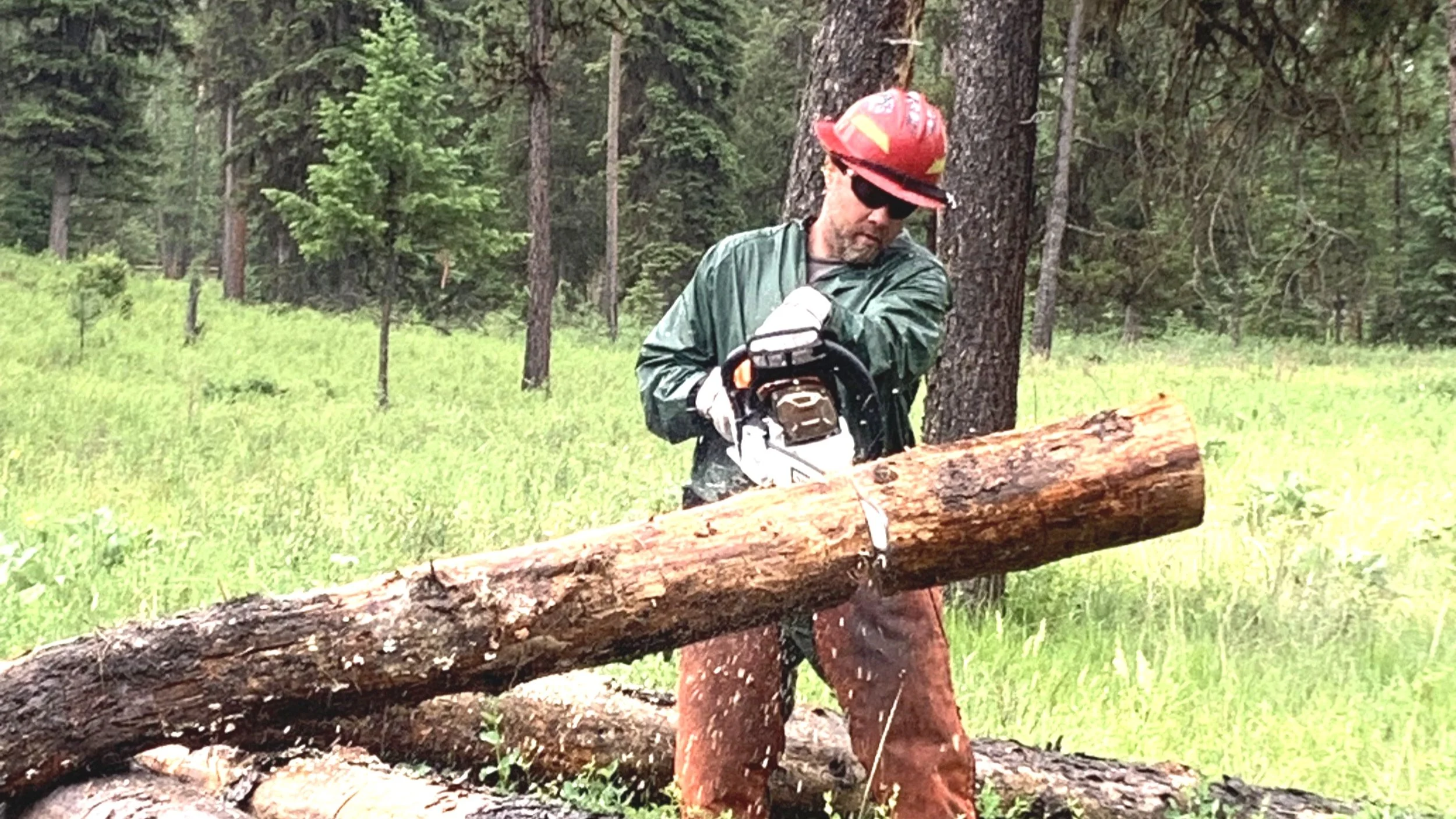
3. Chaps. I’ll admit I bought the whole Husqvarna safety kit. It included chaps, helmet, face shield, ear protection, and gloves. It was required, but I didn’t go to Amazon and poke around for the best deals.
I can’t say I thought I would ever be adding chainsaw chaps to my wardrobe. I guess it’s a Montana fashion. I felt more foolish in the plastic poncho I had to wear because I forgot my rain jacket and it was pouring outside during our class.
I learned that even chaps can’t protect you completely and the teachers did a great job talking about how to position a saw and the risks of being cut from falling and kickbacks.
I’m a firm believer in all of the gear and now I own goggles, ear protecton and chaps. Yeehaw!
4. Gas. Oh, what I learned about premium non-ethanol gas. I mean you can’t just go fill up a chainsaw. It requires premium gas and oil, and rations, ie: math. Now, I own a small gas can for “mixed” gas, another for “old gas” and, another for the 4-wheeler which I use for plowing the snow. Oh, and oil for the chainsaw gas and oil for the chain. On my own I decided that putting an old wet washcloth with a dab of dish soap into a Ziplock baggie is a nice thing to keep in your car for hand cleaning after handling all that gas and oil. (I figured that out on my own.)
5. Safety Break Technique and Fierce Independence. Emma who came out from Kalispell DNRC to evaluate my trees suggested I come to the class. They weren’t grading me, but she did say my property would get a D- on a tree evaluation if there was one. “Too big, too many, a lot to do,” was more or less what I heard from the tree experts. What I also remember them saying is, “A little at a time, it can be done.” With hope I signed up and took the free Chainsaw Workshop which was offered by Swan Valley Connections.
Emma was one of the workshops assistants. Because she had been to my property I think she took a personal interest in my success. She helped me during the actual chain sawing portion of the class. As she watched, she noticed I was expending a lot of effort moving the chain brake on and off. She made a simple suggestion to change my grip away from the throttle to the back of the saw and use only my left hand and wrist to turn the saw off and on. No-brainer for experienced folks.
However, I didn’t know, and her tip helped me realize two things. One, that I shouldn’t dive into this alone. A kindergartner shouldn’t run a chainsaw, and I was basically a kindergartner in the land of power tools. So, I shouldn’t be alone doing this until I have more hours with an experienced person. Period. Don’t be a hero or a lone wolf or a fiercely independent determined chick (which I am or can be.) Be smart and patient. Better technique is not only safer, but also more efficient and that means less fatigue, injuries and hazards.
Two, I don’t know what I don’t know. I didn’t even realize there was a place behind the throttle to hold the handle. I don’t know my away around the pieces and parts. There are so many scenarios that could happen within the elements of nature. A rookie, even smart rookie, couldn’t predict what experienced chainsawers (yea, that’s not even a word) have encountered before. This class was great but it was an introduction, and my saw practice needs to stay within my means. I can’t go all Paul Bunyan on a 6 inch, let alone a 12 inch tree. Emma suggested starting by practicing with stumps or 4 foot broken trees. Great suggestion, I had not thought of that either. So much to learn.
6. Pull in the reins. My goal is to clear the trees. Reality is that I do should do what I can with the shrubs, tiny trees, broken branches and debris. Like many projects in life, clearing my woods, is another lesson in taking one bite at a time.
7. Pie Cut on Compression Side. I had to text the instructions to myself. To cut a tree or buck a log: 1-Offside, 2-Compression, 3-Tension. That’s what I wrote down. However, this implies you know which side of the tree is under tension or compression. Although, it may seem like one could figure it out, I got the jist that even the experts get surprised. And, surprises with powertools and thousand pound trees is a bad combination.
8. Check list. When I read x-rays I have a flow of looking at bones, margins, alignment, soft tissue, etc.… Before I ride my bike, I check that the brakes are locked down, that they work with hand grips, that my tail light is flashing, that my tires are full. I asked if there was a pre-chainsaw checklist of sorts because it seemed like you shouldn’t just grab a saw and stick it full throttle into a tree. In fact, you shouldn’t. There are things like chain tension, bar nuts, and bar oil that need checked. These are handling habits to know and learn with power tools before you ever start. They demonstrated the use of a tourniquet for a reason.
Certainly, I’m a word nerd and liked the buzzwords and slang. I mean, I’m still giggling about “bar nuts and bucking.” I grew up around rodeo and the same words meant completely different things. I was scared out of my mind to take this class and run a chainsaw. But, to me, learning is fun. Maybe it’s my love language. It’s also empowering to be taking this small step in property ownership and ultimately it will provide me a sense of fire safety and pride in my home. Eventually, I’ll be out there revving my throttle like a first grader or second grader. In the meantime, I’ll be keeping the snippers and a handsaw busy. Perhaps, if you are an advanced chainsaw user, you could come work in the woods with me. I’m eager to learn and I need all the help I can get until I take Chainsaw Workshop 201 or, well, until I get that million bucks.
About the Author
Dr. Erika Putnam is a holistic chiropractic physician and credentialed yoga instructor. She works and lives in Whitefish, Montana and writes about health, wellness, yoga, hunting, and outdoor experiences which are the things she enjoys most. As a board member for the Montana Wild Sheep Foundation, she contributes regularly to a column in their publication. She also facilitates a prompt writing class for people interested in healing and has co-authored chapters in several self-healing books. Almost daily she hikes in the sanctuary of the woods with her 2 Vizslas, Zen and Hartty, looking for wildflowers, bears and inspiration.
